
What a patient who doesn’t turn up really costs you
An appointment nobody shows up for isn’t just a quiet half hour. It’s a slot you can no longer sell, a professional waiting and, often, a patient who will take longer to come back and finish their treatment. That’s why it helps to put a figure on it.
The sum is simple: no-shows per week × average revenue per appointment × working weeks per year. For example, a clinic with 6 no-shows a week and average revenue of €60 per appointment loses about €360 a week, over €16,000 a year. Run the numbers with your own figures: they are usually a surprise.
Why patients don’t turn up
- They forget. Especially with appointments booked weeks in advance or check-ups.
- Cancelling feels like a hassle. Calling during reception hours, waiting on the phone or explaining themselves makes many prefer not to say anything.
- Something comes up and they can’t find another slot. If changing the appointment is complicated, they lose it.
- The commitment isn’t clear. Long treatments or free first visits are seen as something that can be skipped.
Almost all of these causes have a solution that doesn’t depend on reception calling patients one by one.
8 measures to reduce no-shows
- Confirmation on booking. As soon as they book, the patient receives the day, time, address, directions and what to bring. They start with a clear reference.
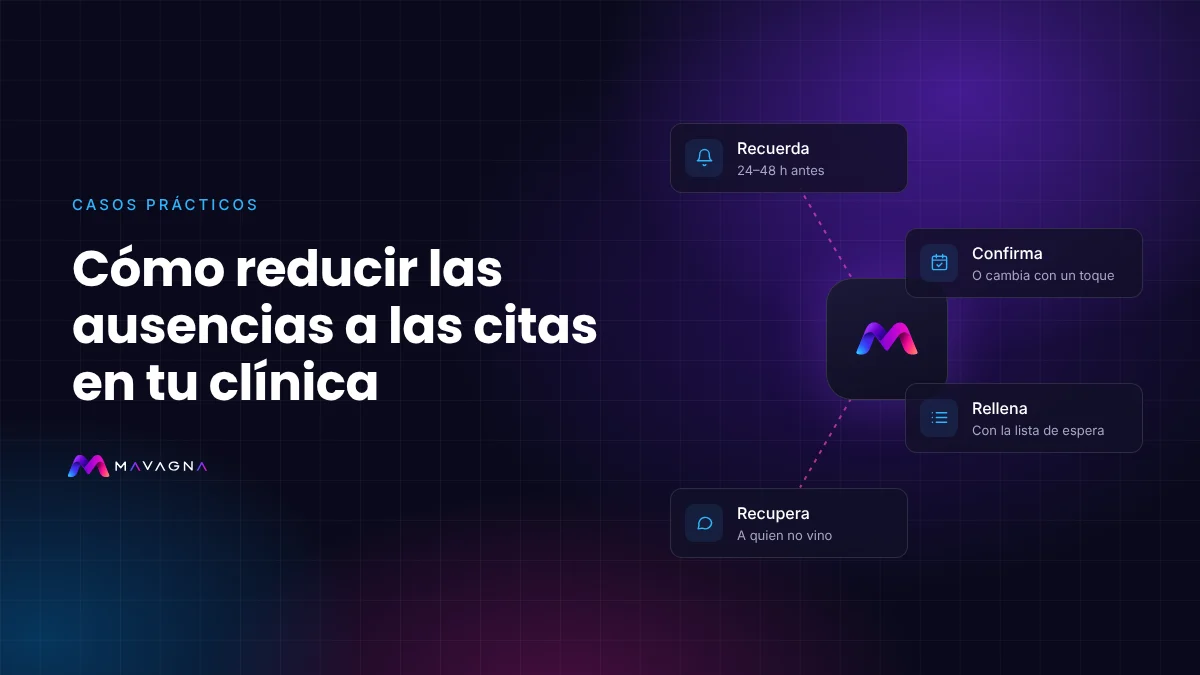
- A reminder 24 to 48 hours before, with a reply. This is the most effective measure. The message doesn’t just remind: it asks the patient to confirm, change or cancel with a button. If they don’t answer, reception knows whom to call.
- A second notice for early appointments. A short message the evening before or a few hours ahead helps with early slots and with the patients who miss most often.
- Easy cancelling and rescheduling, at any hour. A WhatsApp AI agent connected to the diary offers other slots and changes the appointment in the same conversation, also at night or at weekends.
- An automatic waiting list. When someone cancels, the slot is offered straight away to patients who wanted an earlier appointment. The first to accept gets it.
- Follow-up with those who didn’t come. A friendly message the same day proposing a new appointment wins back many patients who would otherwise not return.
- A clear policy for long treatments. Explaining in advance what happens if they don’t give notice, or asking for a deposit on long sessions, strengthens commitment. Check first how to communicate it and what your sector allows.
- Measure. Record no-shows by day, time slot, professional, treatment and the channel used to book. With a few weeks of data you’ll see where they concentrate and whether the measures work.
WhatsApp, SMS or email: which channel to use
| Channel | For | Against |
|---|---|---|
| It’s what people read most, and it lets them confirm or change with one tap in the same conversation | Requires the official WhatsApp Business API and approved message templates, with a small cost per message | |
| SMS | Reaches any mobile, no apps needed | Cost per message and little interaction: changing the appointment means calling or opening a link |
| Free and useful for long instructions (preparation, documents) | Read less and later: it doesn’t work as the only reminder |
The usual approach is to combine them: WhatsApp to remind and confirm, and email for detailed information.
Automatic reminders and GDPR
At a clinic, the mere fact of having an appointment can reveal health information, so messages need care:
- Tell patients when they book that they will receive reminders and on which channel.
- Don’t put the treatment or reason for the visit in the message: the day, time and clinic are enough.
- Use providers with a data processing agreement and don’t share more data than necessary.
- If a virtual assistant replies, the patient must know and be able to speak to a person.
We explain this in more detail on our AI for clinics page.
How it’s set up, step by step
- Connect the diary. If your practice management software has an API or integration, it connects directly; if not, an intermediate calendar is used. It’s the first thing we check.
- Define the messages. Confirmation, reminder, second notice and follow-up, in your clinic’s tone.
- Automate the flow. With a platform such as n8n or Make, each new appointment schedules its notices and each patient reply updates the diary. That’s how our AI automations work.
- Test with real patients for a few weeks and adjust times and wording based on the data.
What it costs
As a guide, automatic reminders with confirmation and review requests cost between €390 and €900 to set up. A complete agent that also books, changes and cancels appointments on WhatsApp and the website costs between €1,490 and €6,000, and you can start with a 30-day pilot for €1,290–1,490. You’ll find all prices on our pricing page.
If you’d like to know how many no-shows your clinic could avoid, ask us for a free assessment: in 30 minutes we review how you manage appointments today and tell you where to start.