
What an AI agent is, explained without jargon
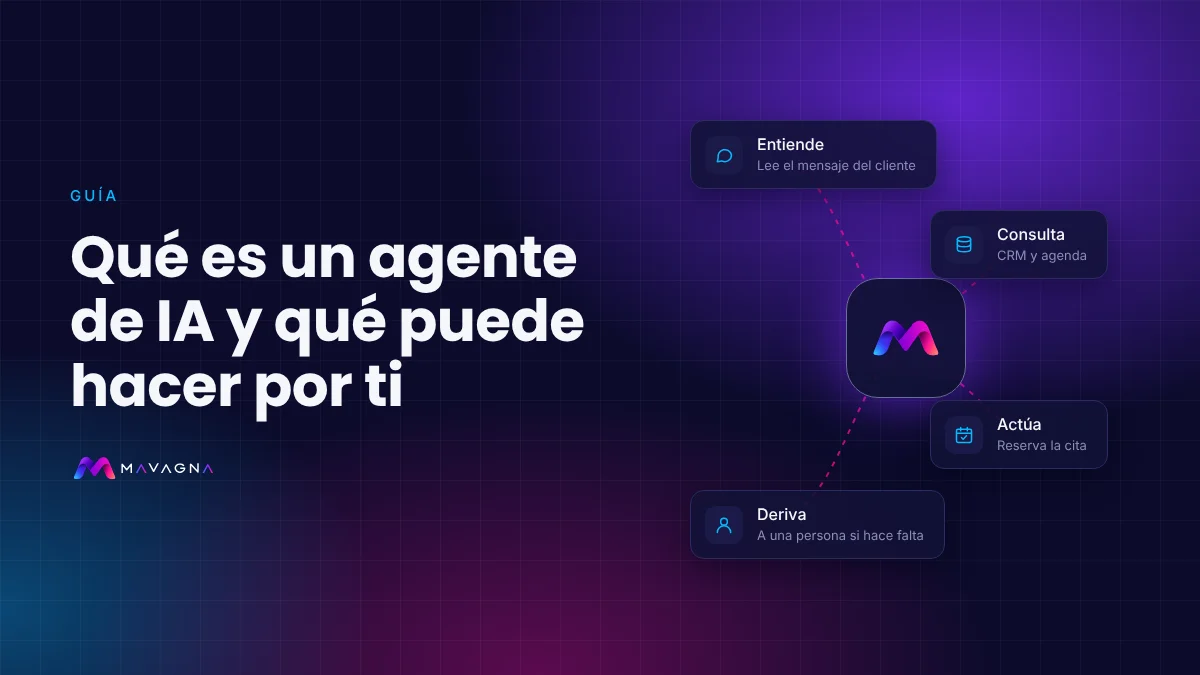
Think of a very fast new employee who knows your business well, has access to some of your tools and follows clear instructions. A customer messages you on WhatsApp; it understands what they need, checks the calendar, offers two time slots, books the appointment and lets your team know. That is an AI agent.
The difference from traditional automation is that the agent understands natural language and decides the next step instead of following a fixed rule. And the difference from ChatGPT is that the agent works with your data and acts in your systems, rather than just chatting.
How an AI agent works
Every AI agent is built from the same pieces:
- An AI model. The “brain” that reads and writes: models such as those from OpenAI, Anthropic (Claude) or Google (Gemini).
- Instructions. What it does, what tone it uses, what it must never answer and when it has to hand the case over to a person.
- Knowledge. Your company’s information: services, prices, opening hours, policies, FAQs or internal documents.
- Tools. The actions it can take: look up or create contacts in the CRM, check the calendar, generate a document or send an email. They are connected through platforms such as n8n or Make.
- Memory and logging. It remembers the context of the conversation and keeps a record of what it has done, so it can be reviewed and improved.
With those pieces, the agent follows a simple cycle: it receives a message, understands the request, decides which tool to use, acts, checks the result and replies. If something doesn’t fit, it hands over to a person with a summary of the conversation.
AI agent, chatbot and assistant: how they differ
| Traditional chatbot | ChatGPT-style assistant | AI agent | |
|---|---|---|---|
| How it replies | With a script of buttons and fixed answers | Understands and writes freely | Understands and writes freely |
| Uses your company’s data | Only what was programmed | No, unless you paste it in | Yes, in a controlled way |
| Takes actions | No | No | Yes: books, checks, creates, sends |
| Example | A “press 1 for opening hours” menu | Drafting an email | Answering on WhatsApp and booking the appointment in your calendar |
Examples of AI agents in business
- Customer service on WhatsApp or on your website. It answers questions about services, prices and timings, checks the status of an order and passes sensitive cases to your team. Here’s how a WhatsApp AI agent works.
- Lead qualification. It talks to everyone who gets in touch, finds out what they need and whether they’re a good fit, and books the meeting with the right salesperson.
- Clinics and appointment-based businesses. It books and changes appointments, sends reminders to reduce no-shows and answers common questions out of hours.
- Estate agencies. It replies to people interested in a property, filters by budget and area, and proposes viewings.
- Back office. It reads invoices and documents, extracts the data and records it, and flags when something is missing.
- Internal assistant. It answers your team with the company’s procedures, catalogues and documents, without digging through folders.
You’ll find more cases in our guide to processes you can automate with AI.
What an AI agent should not do
A good agent has clear limits. It should not make high-impact decisions without supervision (approving large payments, giving diagnoses or legal advice), nor access more data than it needs. In addition, the EU AI Act requires people to be told they are talking to an AI, and the GDPR requires their data to be handled with proper safeguards. That’s why, when we design an agent, we always define what it can do on its own, what it must check and when it hands the case over to a person.
How much does an AI agent cost?
It depends on what it has to do and how many tools need connecting. As a guide, in the Spanish market a custom agent connected to your systems usually costs between €5,000 and €15,000 to implement, plus a monthly usage and maintenance cost; a simple assistant that only answers frequently asked questions costs considerably less. We explain it in detail in how much AI process automation costs.
How to get started
- Pick one specific task that takes up many hours today: answering the same questions over and over, booking appointments or filtering contacts.
- Gather the information the agent will need and decide what it can do on its own and what it can’t.
- Start with a pilot on one channel (WhatsApp, for example) and measure the results for a few weeks before expanding it.
If you’d like to know what an AI agent could do in your business, ask us for an assessment or see how we work on our AI agents service page.